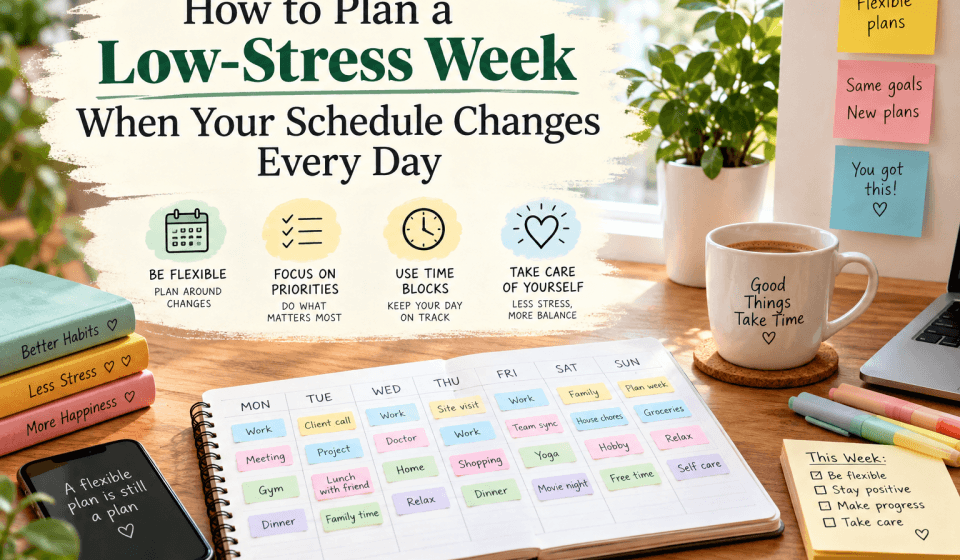

When your work hours, family needs, appointments, or energy levels change from day to day, a rigid weekly schedule can create more stress than it prevents. The better approach is to plan a low-stress week around priorities, flexible time blocks, and realistic backup options. This guide shows you how to organize changing commitments, decide what truly needs to happen, and leave enough breathing room for the unexpected.
Why a Flexible Weekly Plan Works Better
A fixed timetable assumes that every day will go as expected. That may work for a predictable routine, but it becomes frustrating when meetings move, shifts change, children need extra help, or errands take longer than planned.
A flexible plan gives you structure without requiring perfect control. Instead of assigning every hour to a task, you decide:
- Which commitments are fixed and cannot move
- Which tasks matter most this week
- When you are likely to have the time or energy to do them
- What can be postponed if the day changes
- Where you need open space for delays and surprises
The goal is not to fit more into your week. It is to make decisions in advance so that changing circumstances do not force you to start over every morning.
How to Plan a Low-Stress Week in Six Steps
1. Start with a complete list of commitments
Before choosing tasks or setting goals, collect everything that could affect the week. Include work, school, appointments, travel, household responsibilities, social plans, and personal needs.
Use one place for this first review, such as a notebook, calendar, or notes app. Do not rely on memory. A useful list might include:
- Appointments and deadlines
- Work shifts or meetings
- School drop-offs, pickups, or activities
- Medication, exercise, or health-related routines
- Shopping, cooking, laundry, and cleaning
- Bills, phone calls, and administrative tasks
- Events you want to attend
- Travel time and preparation time
At this stage, simply capture the demands. You can decide what deserves attention after you can see the whole picture.
2. Separate fixed commitments from flexible tasks
Divide your list into two broad categories.
Fixed commitments happen at a specific time or have a firm deadline. Examples include a medical appointment, a work shift, a school event, or a bill due on a particular date.
Flexible tasks can happen at different times or may be moved without serious consequences. Examples include vacuuming, replying to non-urgent messages, meal preparation, and buying household supplies.
Put fixed commitments on your calendar first. Add the time needed to get ready and travel, not just the appointment itself. If a meeting runs from 10:00 to 11:00, the real block may need to be 9:30 to 11:30.
Keep flexible tasks in a separate task list until you know how much usable time remains. This prevents your calendar from becoming crowded with tasks that do not actually need a specific slot.
3. Choose three weekly priorities
Changing schedules become easier to manage when you limit the number of outcomes that define a successful week. Choose up to three important priorities, such as:
- Complete a work project by Friday
- Prepare for a school or family event
- Submit an application or handle an important piece of paperwork
Your priorities should be results, not vague intentions. “Get organized” is difficult to act on. “Sort the paperwork and submit the application” is clearer.
After choosing your priorities, break each one into the next few actions. For example, preparing for an event might involve checking the date, buying supplies, washing clothes, and arranging transportation. Small actions are easier to fit into unpredictable days than one large task.
4. Plan by capacity, not just available time
Two hours are not always equal. You may have plenty of time after a long shift, but not enough concentration for complicated work. On another day, you may have less time but more energy.
Label tasks according to the level of effort they require:
- High-focus tasks: writing, studying, planning, problem-solving, or important decisions
- Medium-effort tasks: cooking, routine work, organizing, or standard emails
- Low-effort tasks: folding laundry, listening to a podcast while tidying, filing, or making a simple phone call
Match demanding tasks to the times when you are usually most alert. Save easy tasks for busy days, late afternoons, or periods when interruptions are likely. This approach is more realistic than assuming you can perform at the same level every day.
5. Use time blocks with room to move
Time blocking can help, but it should not turn into an inflexible timetable. Create broad blocks such as “morning,” “early afternoon,” and “evening,” or use two- to three-hour windows for major activities.
For example:
- Monday morning: fixed meeting and travel
- Monday afternoon: one high-focus work task
- Monday evening: simple dinner and laundry
- Tuesday: appointment, grocery shopping, and a short administrative task
Try scheduling only about 60 to 70 percent of your genuinely usable time. The remaining space covers travel delays, unexpected messages, transitions, breaks, and tasks that take longer than expected.
If a day is already unpredictable, plan one essential task rather than filling every open period. A short list that can be completed is more useful than an ambitious schedule that collapses after one interruption.
6. Create a minimum version of the week
Every flexible plan needs a backup version. Decide what “enough” looks like if the week becomes unusually demanding.
Your minimum version might include:
- Completing one key work or study task
- Keeping up with essential meals and medication
- Doing only the most urgent household chores
- Responding to time-sensitive messages
- Getting reasonable rest between commitments
This is not an excuse to abandon responsibilities. It is a way to protect the essentials when circumstances change. Optional cleaning, ambitious exercise goals, and non-urgent errands can move to a later week without making the whole plan feel like a failure.
Build a Weekly Plan That Can Adapt
Use three levels of priority
A simple priority system can help you make quick decisions when your schedule shifts:
- Must do: tasks with serious consequences if missed, such as attending an appointment or meeting a deadline
- Should do: useful tasks that support your goals but can move by a day or two
- Could do: optional tasks that improve your routine but are not urgent
When an unexpected demand appears, remove or postpone a “could do” task first. If more time is needed, move a “should do” task. Avoid automatically sacrificing sleep, meals, or recovery time to preserve every item on your list.
Group similar tasks together
Task switching can make a busy day feel even more scattered. Where possible, group activities by location, equipment, or type of attention.
- Make several phone calls during one quiet period
- Run errands in the same area on one trip
- Prepare two simple meals at the same time
- Handle routine emails together instead of checking them constantly
- Complete small household tasks while waiting for laundry or food
Batching does not mean you must spend an entire day on one category. Even a 20-minute cluster of similar tasks can reduce the mental effort of repeatedly changing focus.
Keep a short “next actions” list
When a task is too large or unclear, write the next physical action instead. “Deal with finances” could become “open the bill,” “check the due date,” or “log in to the account.”
Keep this list short, perhaps five to seven items. A long master list may be useful for storage, but it is not helpful for deciding what to do in a changing day. Each morning, choose the next action that fits your available time and energy.
What to Do When Your Schedule Changes
When a commitment is added or moved, avoid rebuilding the entire week immediately. Use a quick reset:
- Confirm what changed and whether it is genuinely urgent.
- Place the new commitment on your calendar, including travel and preparation.
- Protect your three main priorities if possible.
- Move a flexible task rather than squeezing everything into the same day.
- Choose one realistic next action for the current day.
For example, if an unexpected appointment takes your planned work block, do not try to recover every lost minute. Move the work to the next suitable block, reduce its scope if necessary, and postpone a lower-priority chore.
It can also help to keep a “parking lot” list for tasks that are useful but not time-sensitive. This keeps them visible without letting them compete with urgent responsibilities.
Common Planning Mistakes to Avoid
Overloading the first few days
Many people begin the week with a long list of intentions and leave no room for later commitments. Spread important tasks across the week, and avoid assuming that unfinished work will automatically fit tomorrow.
Ignoring transition time
Travel, getting ready, setting up equipment, and recovering after an appointment all take time. If you schedule only the central activity, your plan may be unrealistic before the day begins.
Treating every task as urgent
If everything is marked urgent, you lose the ability to make sensible trade-offs. Give each task a real deadline or consequence. Some tasks are simply preferable, not essential.
Planning for your ideal energy level
A plan that works only when you are rested, focused, and uninterrupted is not a dependable plan. Include easy alternatives for low-energy periods and expect some days to be less productive.
Using a missed task as evidence that the plan failed
Flexible planning assumes that some tasks will move. Review what changed, decide where the task belongs next, and continue. The purpose of a plan is to guide adjustments, not to create another standard you can fail.
A Simple Weekly Planning Routine
Set aside 20 to 30 minutes before the week begins, or at the start of your first free day. Review fixed commitments, select your priorities, estimate your capacity, and identify likely pressure points.
Then spend five minutes each evening checking the next day. Ask:
- What is fixed tomorrow?
- What is the one task that matters most?
- What can be done if I have extra time?
- What can be postponed without causing a problem?
- Do I need to prepare anything tonight?
This small review keeps your plan current without requiring constant scheduling throughout the day.
Frequently Asked Questions
How many tasks should I plan for each day?
There is no universal number, but one important task plus a few small tasks is often more realistic than a long daily list. Base the number on your fixed commitments, energy, and likelihood of interruptions.
Should I plan every hour of the week?
Usually, no. Schedule fixed commitments and important blocks, then leave open time for travel, breaks, delays, and changing priorities. Broad time windows are often easier to adjust than minute-by-minute schedules.
What if everything feels important?
Compare deadlines, consequences, and whether someone else is depending on you. Handle tasks with immediate consequences first, then choose the next task that supports your most important weekly outcome.
How can I plan when I do not know my work schedule yet?
Keep a list of flexible tasks organized by effort and duration. Once your shifts or appointments are confirmed, place only the best-fitting tasks into the available blocks. Protect essential routines and leave extra space around uncertain commitments.
What should I do when I fall behind?
Pause and reassess rather than adding more pressure. Identify the remaining must-do tasks, move non-urgent items, and create a smaller plan for the next 24 hours. A useful reset is more effective than trying to rescue the original schedule exactly.
Make Flexibility Part of the Plan
A low-stress week is not a week in which nothing changes. It is a week designed to handle change without making every decision feel urgent. Start with fixed commitments, choose a few meaningful priorities, match tasks to your capacity, and leave room for real life.
When your schedule shifts, adjust the plan instead of judging yourself against it. The more often you practice this approach, the easier it becomes to recognize what truly needs your attention and what can wait.