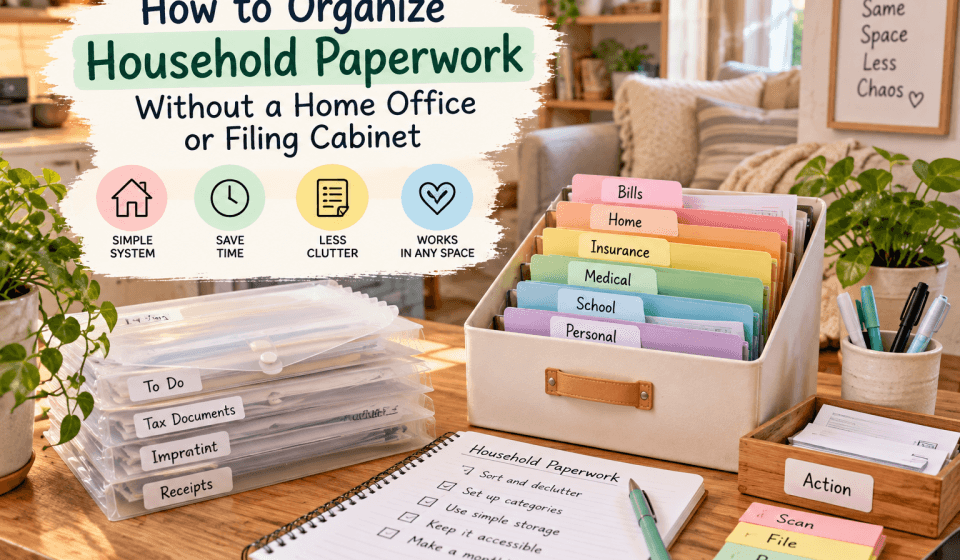

Learning how to organize household paperwork without a home office can make a small space feel calmer and help you find important documents when you need them. You do not need a filing cabinet, dedicated desk, or large storage room. With a portable system, a few clearly labeled categories, and a regular review routine, you can manage bills, medical records, tax documents, warranties, school papers, and personal records in an ordinary closet, cupboard, or drawer.
This guide explains how to create a paperwork system that works in limited space. You will learn what to keep, where to store it, how to handle incoming mail, which documents can be digitized, and how to prevent paper from piling up again.
Start by choosing one small paperwork zone
The first step in organizing household paperwork without a home office is to give every document a defined home. It does not have to be a full room. A single kitchen drawer, a shelf in a hall closet, a lidded storage box, or a section of a bookcase can work well.
Choose a location that is:
- Easy to reach when mail arrives
- Dry and away from direct sunlight
- Large enough for your active papers and a few folders
- Accessible to the adults who need to use it
- Separate from food, cleaning products, and areas that may get damp
A portable file box is especially useful in a small home. You can carry it to the kitchen table when sorting paperwork, then return it to a closet or shelf. If you prefer not to see files at all, use a document box with a lid or a fabric storage cube with file folders inside.
Use a simple four-part paperwork system
Complicated filing systems are difficult to maintain. For most households, four basic destinations are enough:
- Action: Papers that require a payment, signature, response, appointment, or decision.
- Keep nearby: Documents you may need during the current month or year.
- Long-term records: Important documents that should be retained but rarely accessed.
- Recycle or shred: Papers that are no longer useful.
Label folders with these destinations or use more specific labels within them. The key is to make the next action obvious. A bill should not disappear into a folder labeled “Miscellaneous.” It should either be in an “Action” folder with a due date noted or be filed after payment.
Create an action station
Keep one visible folder, basket, or magazine holder for time-sensitive paperwork. Label it “Action” or “To Do.” Use it for bills, renewal notices, permission forms, appointment letters, and documents waiting for a signature.
Do not use this folder as permanent storage. Review it once or twice a week. Write the next step and deadline directly on the paper, or add the task to your calendar. For example, write “Pay by May 14” rather than leaving a bill with no reminder.
Separate current records from permanent records
Current records are papers you may need this year, such as insurance information, appliance receipts, school schedules, or recent medical paperwork. Store these in easy-to-reach folders.
Permanent or long-term records include items such as birth certificates, marriage certificates, property documents, wills, immigration records, and important legal paperwork. Keep these in a more secure, clearly labeled location. A small fire-resistant document bag or locked box may be appropriate for irreplaceable originals.
Sort household paperwork into useful categories
Once you have removed obvious rubbish and duplicates, sort the remaining papers by how you use them. Avoid creating more categories than you can maintain. A practical set of folders might include:
- Identity and legal: Certificates, legal agreements, wills, and powers of attorney
- Money and taxes: Tax records, loan information, investment statements, and bank documents
- Home: Lease or mortgage papers, property records, repair receipts, and contractor information
- Insurance: Policy documents, claim records, and contact details
- Health: Medical summaries, prescriptions, test results, and insurance correspondence
- Vehicles: Registration, title information, service records, and warranties
- Children or school: Enrollment documents, reports, activity information, and care records
- Warranties and manuals: Only for products you still own and may need to repair or replace
If your household is small, combine related categories. For example, “Home and vehicles” may be sufficient. If you have many documents in one area, divide that category by person, property, or year.
Declutter before you buy storage
Buying folders and containers before sorting often results in a larger, better-organized pile of unnecessary paper. Begin by gathering paperwork from countertops, drawers, bags, shelves, and old boxes. Sort it in one session or work through one location at a time.
Use these questions to make decisions:
- Is this an original document that would be difficult to replace?
- Is the information still current?
- Do I need this for taxes, insurance, legal reasons, health care, or a warranty?
- Can I access an official copy online if I need it later?
- Is this a duplicate of a document already stored elsewhere?
Shred papers containing account numbers, identification details, medical information, signatures, or addresses before disposing of them. Plain envelopes, outdated advertisements, and general information that is no longer relevant can usually be recycled according to local rules.
Be cautious with documents that have retention requirements. Rules vary by country and by situation, especially for tax, legal, employment, medical, and property records. If you are unsure, check with the relevant government agency, financial professional, attorney, or service provider before discarding an important document.
Make paper intake easy to manage
Paperwork becomes overwhelming when there is no clear place for new documents. Put an “Inbox” tray or folder near the place where mail enters your home. This is a temporary landing spot, not a storage system.
Process the inbox regularly using this order:
- Open mail and remove unnecessary inserts and envelopes.
- Recycle or shred anything that has no future value.
- Move urgent items to the Action folder.
- Scan or photograph documents you need to retain digitally.
- File the remaining originals in the correct category.
Try to handle each paper once. If a document requires a decision, record the decision or next step immediately. If it belongs in long-term storage, file it rather than placing it back in the inbox.
Choose storage that fits a small home
You can organize paperwork effectively with inexpensive, compact supplies. Choose what fits your space and habits rather than trying to copy a large filing-room system.
- Accordion file: Useful for broad categories in one portable container
- Expanding document wallet: Good for bills, receipts, and papers that travel with you
- Small file box: Holds hanging folders while remaining easy to move
- Binder with labeled dividers: Helpful for household information used frequently
- Zippered document pouch: Suitable for passports, certificates, and other small originals
- Wall-mounted pockets: Useful near an entryway when floor or drawer space is limited
Use broad labels that can be read at a glance. Write the date on folders that hold temporary records, such as “2026 receipts” or “Current insurance.” Clear labels reduce the temptation to create a miscellaneous pile.
Digitize selectively, not automatically
Digital copies can reduce clutter, but scanning everything can create a different kind of mess. Digitize documents that you may need to reference, send, or back up, such as warranties, receipts, insurance policies, and recurring account information.
Use a consistent folder structure, such as:
- Household
- Money and taxes
- Insurance
- Health
- Vehicles
- Home repairs and warranties
Name files clearly with the document type, organization, and date. “2026-04-10 Home insurance policy” is more useful than “scan001.” Back up important digital files and protect them with a strong password and device security.
Do not assume a scan replaces an original. Keep original certificates, signed legal documents, titles, and other papers when an institution may require them. For sensitive records, use a reputable encrypted storage option and avoid leaving personal documents in an unsecured shared folder.
Set a routine that prevents paper piles
A paperwork system only works when it is easy to maintain. Set aside 10 to 15 minutes once or twice a week to empty the inbox, check the Action folder, file completed documents, and shred outdated papers.
Once a month, review recurring paperwork such as bills, subscriptions, insurance notices, and school communications. Once or twice a year, review longer-term files and remove expired records according to appropriate retention guidance.
Keep a small shredding bag or box near your paperwork station. If you do not own a shredder, collect sensitive papers in a secure container and use a reputable shredding service or community shredding event when available.
Common mistakes to avoid
Creating too many categories
Twenty narrowly defined folders may look organized at first but can slow you down. Begin with broad categories and add subfolders only when one section becomes difficult to use.
Using “miscellaneous” for everything
A miscellaneous folder quickly becomes a hidden pile. If you cannot decide where a paper belongs, ask what action or future use it has. Create a specific category only if similar papers appear regularly.
Keeping every receipt
Keep receipts for returns, warranties, reimbursements, taxes, business expenses, and major purchases when they have a clear purpose. Do not let ordinary receipts accumulate indefinitely without a review date.
Putting urgent papers out of sight
Important paperwork that is hidden may be forgotten. Keep time-sensitive items in a visible Action folder, and use calendar reminders for deadlines.
Storing irreplaceable documents casually
Birth certificates, passports, property titles, and legal originals should not be left in an open basket. Store them in a secure, protected location that household members can access when necessary.
FAQ about organizing paperwork in a small home
What is the best way to organize household paperwork without a filing cabinet?
Use a portable file box, accordion folder, or binder with broad labeled categories. Add one separate Action folder for documents that need attention soon and a secure pouch or box for irreplaceable originals.
How long should I keep household documents?
It depends on the document and your circumstances. Keep permanent legal and identity records, and check applicable guidance for tax, medical, employment, property, and financial documents before discarding them.
Where should I keep bills that have not been paid?
Place them in a clearly labeled Action folder, then write the due date on the bill or add a reminder to your calendar. Move the document to its regular category after payment or completion.
Should I scan all my paperwork?
No. Scan useful reference documents and backups, but keep originals when they have legal, identity, financial, or practical importance. Use clear file names and back up sensitive digital records.
How can I stop paperwork from building up again?
Process incoming mail near the point of entry, remove junk immediately, and review your Action and Inbox folders on a fixed weekly schedule. A short routine is easier to maintain than occasional large-scale sorting.
The most effective paperwork system is not the one with the most folders. It is the one that gives every document a clear destination, protects important originals, and makes weekly maintenance quick. With a portable container, a small set of categories, and a reliable intake routine, you can keep household records under control even without a home office or filing cabinet.